 Dentalingo
Reference chart
Tooth numbering chart: Universal, Palmer and FDI
Every permanent and primary tooth in the three numbering systems in common use, on one chart. Choose a tooth to see its Universal number, its Palmer designation and its FDI number; the tables below list them all.
Tooth numbering chart
maxillary left first molar
Quadrant: upper left
- Universal
- 14
- Palmer
- upper left 6
- FDI
- 26
- Said “two-six”
Drawn as if you face the patient, so the patient’s right is on your left. Tap a tooth, or use the arrow keys to walk the chart in Universal order.
How the three systems work
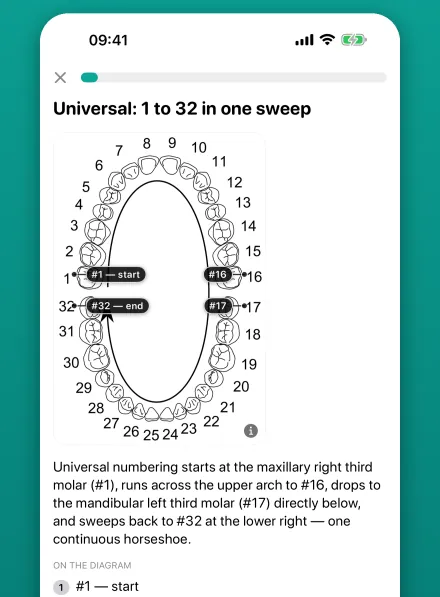
Universal: 1 to 32
Universal numbering gives each permanent tooth its own number. It starts at the maxillary right third molar as 1 and runs across the upper arch to 16, the maxillary left third molar; it continues with the mandibular left third molar as 17 and runs back along the lower arch to 32. The number alone names the tooth, with no R or L: tooth 3 is the maxillary right first molar and tooth 24 the mandibular left central incisor.
The Navy’s dental manual describes it as approved by the American Dental Association and used by the armed services, and tells the assistant to chart a tooth by its number rather than its name.
Sources: Dental Anatomy and Physiology (subcourse MD0501), 4-6. Numbering of teeth; Dental Technician, Volume 1 (NAVEDTRA 14274), Universal Numbering System.
Universal for primary teeth: A to T
The 20 primary teeth take capital letters along the same path: A is the maxillary right second primary molar, J the maxillary left second primary molar, K the mandibular left second primary molar below it, and T the mandibular right second primary molar.
Source: Dental Technician, Volume 1 (NAVEDTRA 14274), Universal Numbering System.
FDI: two digits
The FDI system gives every tooth two digits. The first is the quadrant: 1 upper right, 2 upper left, 3 lower left and 4 lower right, clockwise around the mouth. The second counts the teeth from the midline back, 1 for the central incisor to 8 for the third molar. So 26 is the upper left first molar, said “two-six”; in Universal numbers the same tooth is 14.
Source: Forensic odontology in DVI: current practice and recent advances, Written dental records.
Primary teeth use quadrants 5 to 8 in the same order, with the teeth counted 1 to 5 from the midline: 55 is the upper right second primary molar and 85 the lower right one.
Source: FDI World Dental Federation notation, Table of codes.
Palmer: a number in a corner
Palmer notation also counts the teeth 1 to 8 from the midline back in each quadrant, and shows the quadrant with a grid symbol: the number sits in one corner of a cross that stands for the midline and the line between the arches, as you face the patient. The upper right first molar is a 6 with the lines on its right and below it; the upper left one has them on its left and below.
Sources: Forensic odontology in DVI: current practice and recent advances, Written dental records; Palmer notation, Palmer notation and Table of codes.
Primary teeth take the letters A to E, from the midline back, inside the same corners.
Source: Palmer notation, Palmer notation and Table of codes.
None of the three systems has gained full international acceptance, and none of them copes with supernumerary (extra) teeth.
Source: Forensic odontology in DVI: current practice and recent advances, Written dental records.
Landmarks worth memorizing
- Universal 1, 16, 17 and 32 are the four third molars; 8 and 9 are the upper central incisors, either side of the midline, and 24 and 25 the lower ones.
- FDI 11, 21, 31 and 41 are the four central incisors, and 18, 28, 38 and 48 the four third molars.
- In FDI the second digit names the tooth: a 3 is always a canine (13, 23, 33 and 43; 53, 63, 73 and 83 in primary teeth), and a 6 always a permanent first molar (16, 26, 36 and 46).
- In Palmer the canines are 3 in the permanent teeth and C in the primary teeth.
- Universal A, J, K and T are the four second primary molars, and E, F, O and P the four primary central incisors.
Every tooth in all three systems
| Tooth | Universal | Palmer | FDI |
|---|---|---|---|
| upper right quadrant | |||
| maxillary right third molar | 1 | upper right 8 | 18 |
| maxillary right second molar | 2 | upper right 7 | 17 |
| maxillary right first molar | 3 | upper right 6 | 16 |
| maxillary right second premolar | 4 | upper right 5 | 15 |
| maxillary right first premolar | 5 | upper right 4 | 14 |
| maxillary right canine | 6 | upper right 3 | 13 |
| maxillary right lateral incisor | 7 | upper right 2 | 12 |
| maxillary right central incisor | 8 | upper right 1 | 11 |
| upper left quadrant | |||
| maxillary left central incisor | 9 | upper left 1 | 21 |
| maxillary left lateral incisor | 10 | upper left 2 | 22 |
| maxillary left canine | 11 | upper left 3 | 23 |
| maxillary left first premolar | 12 | upper left 4 | 24 |
| maxillary left second premolar | 13 | upper left 5 | 25 |
| maxillary left first molar | 14 | upper left 6 | 26 |
| maxillary left second molar | 15 | upper left 7 | 27 |
| maxillary left third molar | 16 | upper left 8 | 28 |
| lower left quadrant | |||
| mandibular left third molar | 17 | lower left 8 | 38 |
| mandibular left second molar | 18 | lower left 7 | 37 |
| mandibular left first molar | 19 | lower left 6 | 36 |
| mandibular left second premolar | 20 | lower left 5 | 35 |
| mandibular left first premolar | 21 | lower left 4 | 34 |
| mandibular left canine | 22 | lower left 3 | 33 |
| mandibular left lateral incisor | 23 | lower left 2 | 32 |
| mandibular left central incisor | 24 | lower left 1 | 31 |
| lower right quadrant | |||
| mandibular right central incisor | 25 | lower right 1 | 41 |
| mandibular right lateral incisor | 26 | lower right 2 | 42 |
| mandibular right canine | 27 | lower right 3 | 43 |
| mandibular right first premolar | 28 | lower right 4 | 44 |
| mandibular right second premolar | 29 | lower right 5 | 45 |
| mandibular right first molar | 30 | lower right 6 | 46 |
| mandibular right second molar | 31 | lower right 7 | 47 |
| mandibular right third molar | 32 | lower right 8 | 48 |
| Tooth | Universal | Palmer | FDI |
|---|---|---|---|
| upper right quadrant | |||
| maxillary right second primary molar | A | upper right E | 55 |
| maxillary right first primary molar | B | upper right D | 54 |
| maxillary right primary canine | C | upper right C | 53 |
| maxillary right primary lateral incisor | D | upper right B | 52 |
| maxillary right primary central incisor | E | upper right A | 51 |
| upper left quadrant | |||
| maxillary left primary central incisor | F | upper left A | 61 |
| maxillary left primary lateral incisor | G | upper left B | 62 |
| maxillary left primary canine | H | upper left C | 63 |
| maxillary left first primary molar | I | upper left D | 64 |
| maxillary left second primary molar | J | upper left E | 65 |
| lower left quadrant | |||
| mandibular left second primary molar | K | lower left E | 75 |
| mandibular left first primary molar | L | lower left D | 74 |
| mandibular left primary canine | M | lower left C | 73 |
| mandibular left primary lateral incisor | N | lower left B | 72 |
| mandibular left primary central incisor | O | lower left A | 71 |
| lower right quadrant | |||
| mandibular right primary central incisor | P | lower right A | 81 |
| mandibular right primary lateral incisor | Q | lower right B | 82 |
| mandibular right primary canine | R | lower right C | 83 |
| mandibular right first primary molar | S | lower right D | 84 |
| mandibular right second primary molar | T | lower right E | 85 |
Practice it
The DANB® AMP exam outline lists tooth numbering systems, including the Universal and Palmer systems, among its topics. The free Anatomy, Morphology and Physiology practice test samples head, neck and tooth anatomy from the app’s 320 questions for the exam, each traced to its source.
Start the Anatomy, Morphology and Physiology practice testAbout the exam
In the app
Learn the numbering in Dentalingo
Dentalingo’s atlas has a numbering systems module: nine illustrated cards on the Universal, Palmer and FDI systems, then seven questions to test yourself.
The app also has 1,520 practice questions across the RHS®, ICE®, GC, AMP and CP exams, with every answer explained and checked against a cited source, and a timed mock exam for each.
The first 7 questions are free. After that, full access is a Study Camp subscription; the App Store shows the price in your country. The numbering module comes with Study Camp. More about the app

Scan to get Dentalingo on your iPhone.
 Spaced review of what you missed
 Tooth numbering, in the atlas
 XP and accuracy over time

Sources
Each rule above comes from one of these. The two manuals are the ones the practice questions cite; the Wikipedia revisions are the ones the app’s own numbering cards cite, read for the facts and not copied.
- Dental Anatomy and Physiology (subcourse MD0501)U.S. Army Medical Department Center and School · 4-6. Numbering of teeth · U.S. government work, public domain
- Dental Technician, Volume 1 (NAVEDTRA 14274)U.S. Navy, 1999 · Universal Numbering System · U.S. government work, public domain
- Forensic odontology in DVI: current practice and recent advancesAlex Forrest, Forensic Sciences Research, 2019 · Written dental records · CC BY 4.0
- FDI World Dental Federation notationWikipedia, revision of April 4, 2026 · Table of codes · Read for the facts, not copied
- Palmer notationWikipedia, revision of July 30, 2026 · Palmer notation and Table of codes · Read for the facts, not copied