
Skip to content

Free practice test 2 · from 200 questions

Coronal Polishing practice test 2, every answer explained

Another free sample from Dentalingo’s 200 questions for the DANB® CP exam, none of them from practice test 1. Tap an answer to see at once whether it’s right, why, and the source it was checked against. The other 190, a timed mock exam and spaced review are in the app.

The format and domains are in the Coronal Polishing exam guide; how the questions are checked is on the sources page.

Question 1

Equipment and Supplies

Materials handled at the chair can attack the glove that touches them. Whom does CDC say the practitioner should consult about that?

Tap an answer

Answer: B. The glove manufacturer, on compatibility with the materials in use

Because the range of dental materials on the market is wide, CDC sends the question to the party that knows how the glove itself behaves, and asks about chemical compatibility with those materials. No approved list from a licensing board, in-house batch testing, or certification running the other way is described in the guidance.

Source: Guidelines for Infection Control in Dental Health-Care Settings, 2003, Centers for Disease Control and Prevention (MMWR 52, RR-17); section “Glove Integrity”. U.S. government work, public domain.

Question 2

Equipment and Supplies

Under the bloodborne pathogens standard, protective equipment counts as appropriate only on one condition. What is that condition?

Tap an answer

Answer: A. That in normal use, for the whole time it is worn, nothing gets through

The rule sets a performance condition and bounds it twice over: through normal use, and for as long as the equipment is worn, nothing infectious may reach the wearer's clothing, skin or mucous membranes. The standard imposes no product-marking test at all, and disposal and the exposure control plan are dealt with by separate provisions.

Source: 29 CFR 1910.1030, Bloodborne Pathogens, Occupational Safety and Health Administration; section “1910.1030(d)(3)(i)”. U.S. government work, public domain.
Question 3

Procedures

A counter has visible paste and saliva on it. Why does CDC insist it is scrubbed before any germicide is applied?

Tap an answer

Answer: B. Scrubbing lifts the soil that would otherwise blunt the germicide

Organic debris shields organisms from a chemical and consumes the active ingredient before it can work. Physical scrubbing with detergent removes both the debris and a large share of the organisms with it. Skip that step and the disinfection that follows cannot be relied on.

Source: Guidelines for Infection Control in Dental Health-Care Settings, 2003, Centers for Disease Control and Prevention (MMWR 52, RR-17); section “Environmental Infection Control”. U.S. government work, public domain.

Question 4

Procedures

As the rubber cup is carried through a full-mouth coronal polish, when does the operating hand need a firm rest established?

Tap an answer

Answer: B. At every point, from the first tooth polished to the last

The rest goes down before the cup meets the tooth and is re-set as the operator moves on, because the moment support is easiest to lose is the moment the hand travels to a new area. A cup that skids off enamel reaches gingiva whether or not it is loaded, and a tooth being easy to see does nothing to steady the hand.

Source: Preventive Dentistry (subcourse MD0513), U.S. Army Medical Department Center and School; section “3-14b. Procedure”. U.S. government work, public domain.

Question 5

Procedures

A supplier offers a polishing handpiece that cannot withstand a heat cycle and carries no FDA clearance with validated reprocessing instructions. The correct response is to:

Tap an answer

Answer: C. Decline it, because such a device is not to be used at all

This is one of the few places where the guidance rules out a whole device rather than prescribing a method. If it cannot take heat and its maker has not had a reprocessing method cleared, there is no way left to make it safe between patients. Screening patients does not help, because infection status is often unknown, and limiting what the device is used for does not change what gets inside it.

Source: Best Practices for Dental Handpieces, Centers for Disease Control and Prevention; section “Key points”. U.S. government work, public domain.

Question 6

Procedures

Which item is used to carry polishing paste onto the surfaces that face the neighbouring teeth?

Tap an answer

Answer: A. Unwaxed dental floss, or a length of tape, drawn through

The manual assigns a carrier to each surface, and this surface goes to unwaxed dental floss or tape: the rubber cup and the stiff-bristled brush are named for other surfaces in the same list. It gives no reason for the unwaxed form over a waxed one, so none is offered here. A wedge belongs to matrix work and carries no polishing agent at all.

Source: Preventive Dentistry (subcourse MD0513), U.S. Army Medical Department Center and School; section “3-21. POLISHING WITH PROPHYLAXIS PASTE”. U.S. government work, public domain.

Question 7

Procedures

Which of these is barred outright from an operatory where occupational exposure is reasonably likely?

Tap an answer

Answer: D. Drinking, smoking, lip balm and handling contact lenses

The prohibition covers a group of hand-to-face and hand-to-mouth activities, not food alone, and it applies to the work area rather than to a particular spot in it. All of them give contamination on the hands a direct route to a mucous membrane. Wiping the surfaces does not lift the ban.

Source: 29 CFR 1910.1030, Bloodborne Pathogens, Occupational Safety and Health Administration; section “1910.1030(d)(2)(ix)”. U.S. government work, public domain.

Question 8

Procedures

What consistency should the polishing paste have when it is applied?

Tap an answer

Answer: C. Thick and stiff, close to the feel of window putty

A stiff mix holds its abrasive against the tooth instead of being flung off the cup, and holding it there is where the cleaning actually happens. The comparison this text draws is with putty rather than with anything pourable. A watery mix and a completely dry one both fail, for opposite reasons.

Source: Preventive Dentistry (subcourse MD0513), U.S. Army Medical Department Center and School; section “3-21. POLISHING WITH PROPHYLAXIS PASTE”. U.S. government work, public domain.

Question 9

Procedures

The gloves come off at the end of a polishing appointment and the hands look clean. What does CDC ask for?

Tap an answer

Answer: A. Washing the hands again at once, before anything else is touched

CDC puts a wash on both sides of gloving: the hands are dried before the gloves go on, because bacteria multiply fast in the damp underneath them, and washed again the moment the gloves come off. Whether the gloves looked intact when they were removed does not change that, and a rinse under water on its own is not hand hygiene.

Source: Guidelines for Infection Control in Dental Health-Care Settings, 2003, Centers for Disease Control and Prevention (MMWR 52, RR-17); section “Gloves and Gloving”. U.S. government work, public domain.

Question 10

Procedures

While the cup is turning against a tooth surface, how should the operator be handling it?

Tap an answer

Answer: D. Slid along without pause, never left standing on one spot

A cup left standing on one spot concentrates the abrasive and the friction in a single place, which is how enamel is needlessly thinned and the pulp warmed. Keeping it travelling spreads that work across the surface so no one point heats up. Bearing down harder or winding the speed up are not answers either, since both add the very friction the movement is there to disperse.

Source: Dental Technician, Volume 2 (NAVEDTRA 14275), U.S. Navy, 1999; section “Precautions”. U.S. government work, public domain.

Answer every question to see your score and how it splits by domain.

200 questions in the app

Keep going in Dentalingo

The other 190 questions for the DANB® CP exam, with the same explanations, lessons across its four domains, and a mock exam of 80 questions in 60 minutes.

The first 7 questions are free. After that, full access is a Study Camp subscription; the App Store shows the price in your country. More about the app

Download on the App Store
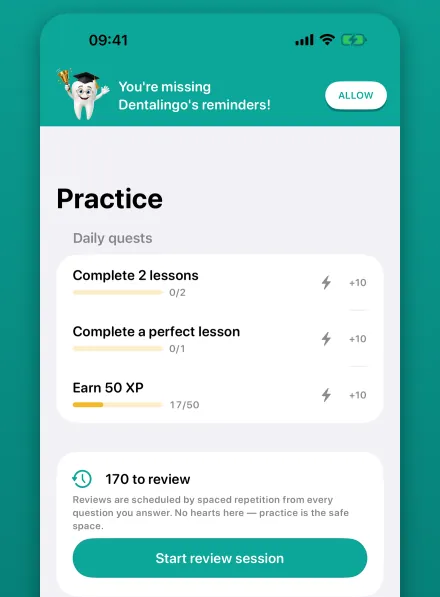
  • Dentalingo's Practice screen: daily quests and the questions due for spaced-repetition review.Spaced review of what you missed
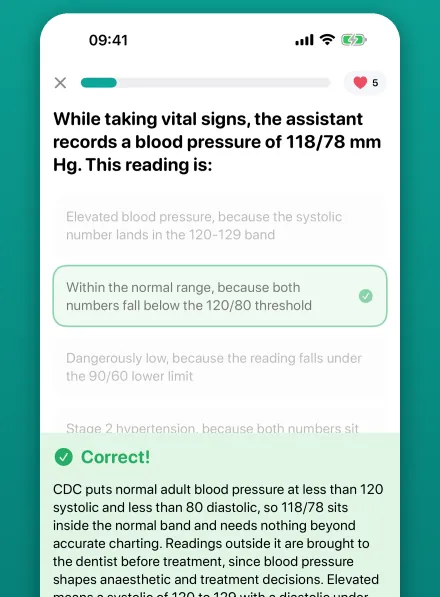
  • Dentalingo's question screen: a chairside question about a blood pressure reading, answered correctly, with the explanation below the options.Answers explained the moment you choose
  • Dentalingo's Stats screen: answers graded, XP per day and an accuracy trend.XP and accuracy over time

Think an answer is wrong? Write to us with the question number and the page; every question is checked against its source, and a confirmed error is corrected in the app as well.