Skip to content

Free practice test · from 330 questions

General Chairside Assisting practice test, every answer explained

A free sample from Dentalingo’s 330 questions for the DANB® GC exam. Tap an answer to see at once whether it’s right, why, and the source it was checked against. The other 320, a timed mock exam and spaced review are in the app.

The format and domains are in the General Chairside Assisting exam guide; how the questions are checked is on the sources page.

Question 1

Evaluation

In this cut-through of a tooth, one tissue fills most of the crown and both roots, lying between the thin outer cap and the central chamber. That tissue is:
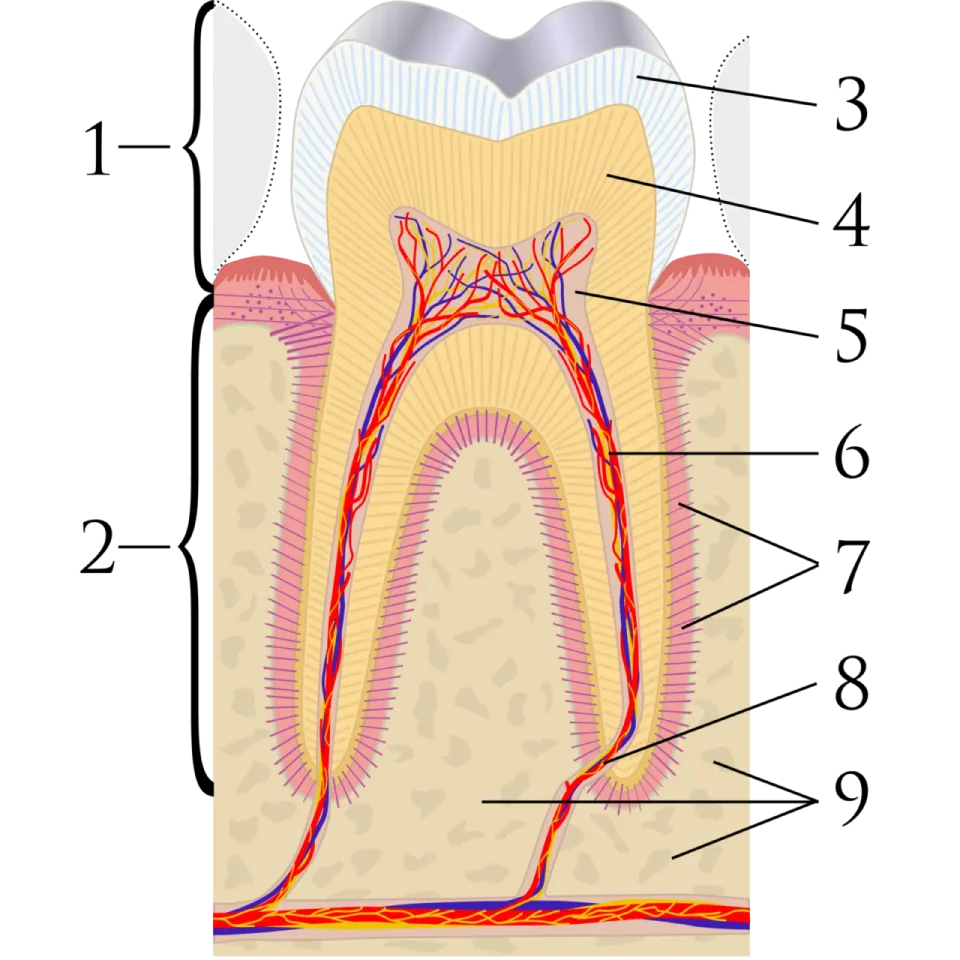
Colour drawing of a single tooth cut through lengthways in its socket, with a greyed-out neighbour on each side. The crown has a wide chewing surface with rounded rises and a dip between them, capped by a thin striped outer layer; beneath it a large fan of fine lines fills the body of the tooth. Two separate roots run down into the bone, each holding a channel of red, blue and yellow strands that meet in a chamber under the crown. Eight plain leader lines run out to the right, none of them carrying any label.
Image: Ian Furst, Goran tek-en · CC BY-SA 3.0 · source

Tap an answer

Answer: C. Dentin

Dentin makes up the bulk of a tooth: it is a calcified tissue, softer than enamel but harder than bone, and it runs from under the enamel of the crown right down inside the root under the cementum. Its inner surface forms the hard-walled cavity that holds and protects the pulp, which is the soft tissue of vessels and nerves in the chamber at the centre. Enamel is only the thin covering over the crown, and cementum is the thin covering over the root - neither is the body of the tooth.

Source: Dental Anatomy and Physiology (subcourse MD0501), U.S. Army Medical Department Center and School; section “3-6. TISSUES OF THE TEETH”. U.S. government work, public domain.
Question 2

Evaluation

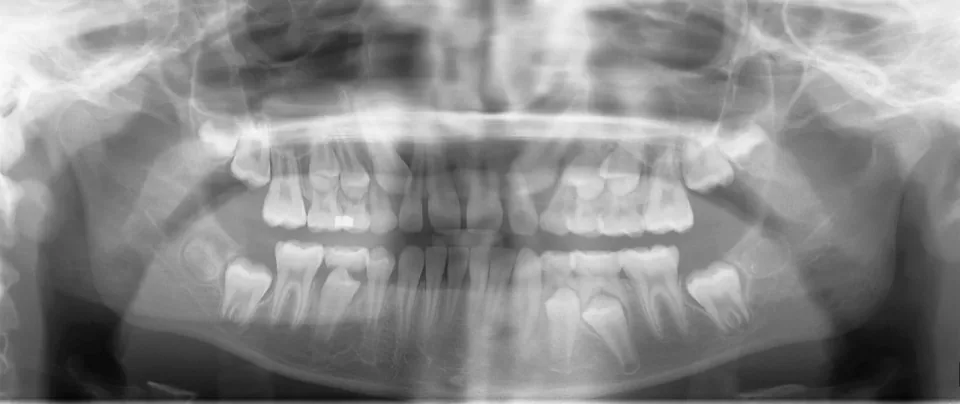
The panoramic radiograph shows a child's jaws, with primary teeth still standing in the arches and permanent teeth forming in the bone beneath them. A complete primary set and a complete permanent set contain, in that order:

Panoramic radiograph of a child's upper and lower jaws. Toward the back of each arch a broad tooth stands in the arch with a smaller crown forming in the bone directly beneath it; several of the teeth already in the mouth still have wide, open, unfinished root ends; and further crowns sit unerupted in the bone behind the last of the erupted ones.
Image: Coronation Dental Specialty Group · CC BY 3.0 · source

Tap an answer

Answer: D. 20 primary teeth and 32 permanent teeth

A person has two sets of teeth in a lifetime: a primary set of 20, also called deciduous or temporary, and a permanent set of 32 that follows it. For several years both are present together, which is the stage a radiograph like this one catches. The 28-tooth answer is tempting because that is what is left of the permanent set once the four third molars are set aside, but the count of the set itself is 32.

Source: Dental Anatomy and Physiology (subcourse MD0501), U.S. Army Medical Department Center and School; section “4-1. GENERAL”. U.S. government work, public domain.
Question 3

Patient Management and Administration

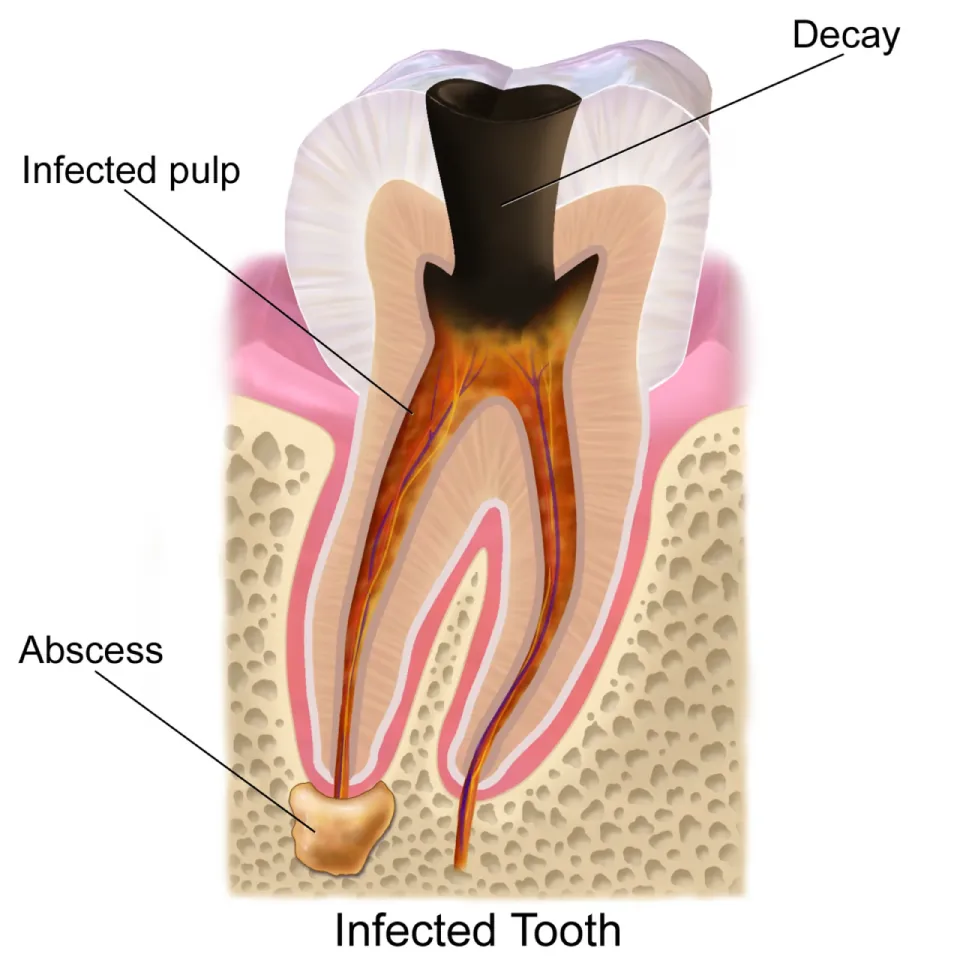
A patient is shown this cross-section of a tooth in which decay has been left untreated. She says her own teeth cannot be decayed, because none of them hurt. What should the assistant tell her?

Cross-section of a two-rooted molar in bone: a black channel of decay runs from the chewing surface through enamel and dentin into the discoloured pulp, and leader lines label Decay, Infected pulp and a pale rounded Abscess at one root tip, under the caption Infected Tooth.
Image: BruceBlaus (Blausen Medical) · CC BY 3.0 · source

Tap an answer

Answer: C. Early decay does not usually cause symptoms, so it is found at a check-up, not felt

Decay is well advanced before it announces itself. In early tooth decay there are usually no symptoms at all; pain, or sensitivity to sweet, hot or cold, arrives only as the decay advances - by which point it is past the stage that fluoride and better plaque control can still reverse. A painless mouth is therefore not evidence of a sound one, and that is why decay is found at an examination rather than felt. The picture shows where an untreated cavity finally arrives: through the enamel and dentin, into the tissue at the centre of the tooth, and out into the bone at the root tip. Cold sensitivity is not a universal first sign, decay does not reliably hurt on biting, and the loss of mineral from enamel is silent.

Source: Tooth Decay, National Institute of Dental and Craniofacial Research; section “Symptoms”. U.S. government work, public domain.
Question 4

Patient Management and Administration

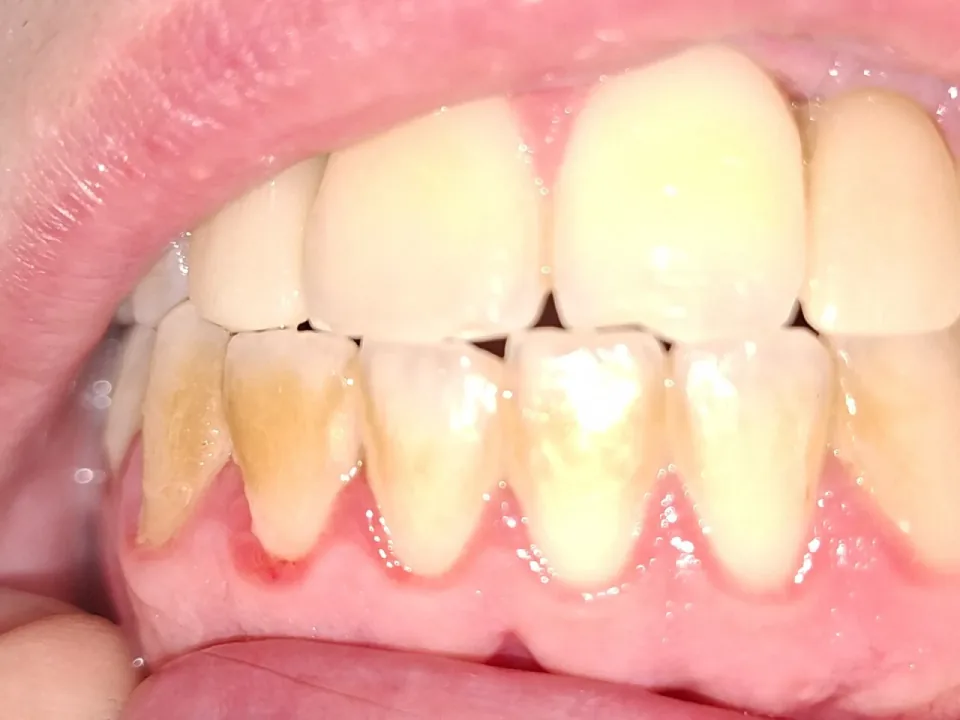
The lower front teeth in this photograph carry a heavy deposit along the gumline, with the gum beside one of them reddened, and the dentist charts early gum disease. The patient asks whether her gums are now permanently damaged. What should the assistant tell her?

Close intraoral photograph with the lower lip drawn down by a finger, both front arches in frame with the teeth together. The upper incisors are pale and clean. Across the necks of the lower front teeth lies a thick yellow-brown build-up following the gumline, heaviest on the left of the frame. The gum is pale pink along most of its margin, with one small reddened area low on the left. No arrow, letter or marker appears.
Image: Roquex · CC0 1.0 · source

Tap an answer

Answer: B. The inflammation settles and the tissue recovers once the deposits are cleared

Gingivitis is inflammation of the gum tissue alone. Early gum disease, caused by plaque buildup, can often be reversed by daily brushing and flossing - once the hardened deposits a toothbrush cannot shift have been cleared professionally. What does not come back is what periodontitis takes: when the disease reaches the bone that supports the teeth, that support is lost for good and teeth may loosen. Whether it ever gets that far depends heavily on what she does at home, so telling her the damage is already permanent removes her main reason to change anything. Diet is not the cause here; the deposits are.

Source: Periodontal (Gum) Disease, National Institute of Dental and Craniofacial Research; section “Treatment”. U.S. government work, public domain.
Question 5

Chairside Dentistry

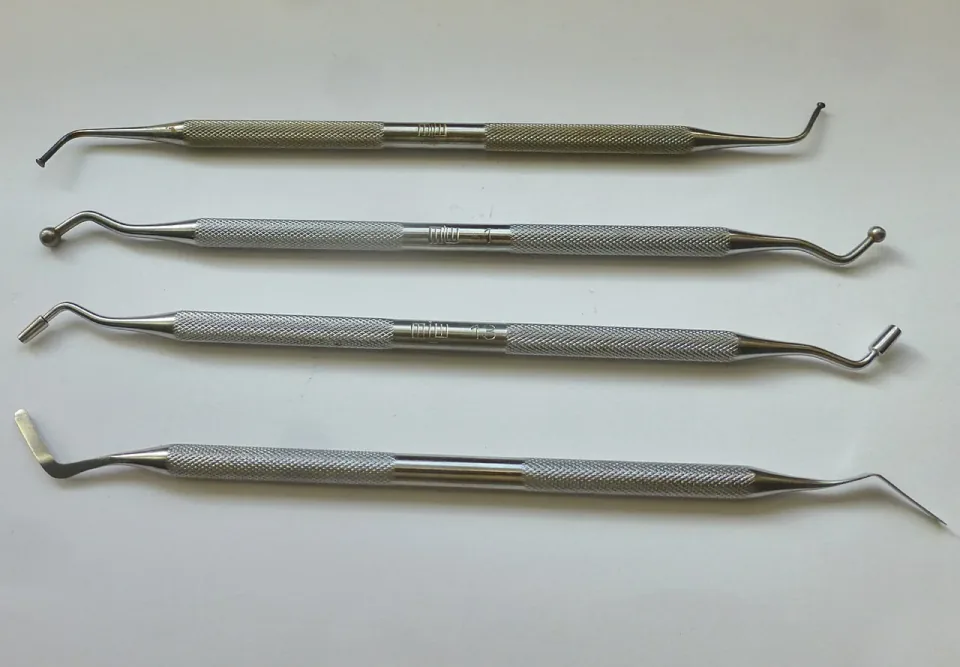
The dentist has just ejected the first portion of amalgam into the preparation from the carrier. Which of the four instruments shown should the assistant pass next?

Four double-ended stainless steel hand instruments lie parallel on a pale surface: one with a small angled flat blade at one end and a tiny ball at the other, one with a round ball at each end, one with short flat-faced cylindrical ends, and one with a broad flat paddle at one end and a long slim pointed blade at the other.
Image: Symposius · CC BY-SA 4.0 · source

Tap an answer

Answer: D. The one with short flat-faced cylindrical ends, to compress the material

Amalgam goes in a portion at a time, and each portion is compressed into the preparation before the next arrives. That is the condenser's work: a hammer-like working end, broad enough to compress the soft amalgam without sinking into it, on a single- or double-ended instrument whose faces may be smooth or serrated. The carrier-and-condenser exchange repeats until the cavity is slightly overfilled; only then do the carvers shape the surface back to the contour of the tooth and a burnisher smooth it. Amalgam is triturated in an amalgamator, never mixed on a pad.

Source: Dental Technician, Volume 2 (NAVEDTRA 14275), U.S. Navy, 1999; section “CONDENSERS”. U.S. government work, public domain.
Question 6

Chairside Dentistry

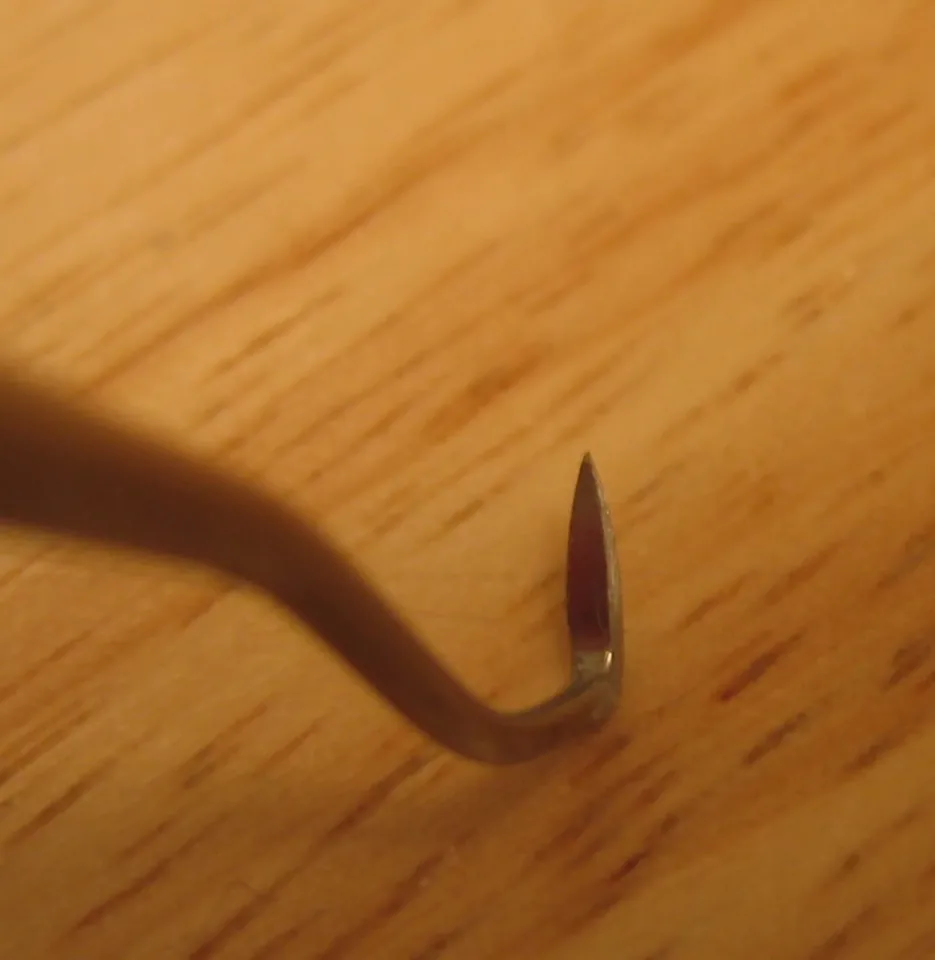
This close-up shows the sharpened end of a scaler, the part that is worked against the tooth. On a cutting hand instrument, what is this part called?

Macro photograph on a pale wooden surface of the far end of a hand scaler: a slim metal rod bends twice and finishes in a short flattened taper that rises to a fine sharp point, with the handle out of frame.
Image: DRosenbach · Public domain · source

Tap an answer

Answer: A. The blade

A dental hand instrument has four parts: the handle the operator holds, the shank that joins the handle to the business end, the blade or nib itself, and the cutting edge or face at its very tip. On a cutting instrument such as a scaler that end is a blade carrying a cutting edge; a non-cutting instrument ends in a nib with a face or point instead. Naming the parts precisely matters when instruments are identified from a setup, transferred, and checked for damage before sterilization.

Source: Dental Instrument Setups (subcourse MD0503), U.S. Army Medical Department Center and School; section “PARTS OF DENTAL HAND INSTRUMENTS”. U.S. government work, public domain.
Question 7

Chairside Dentistry

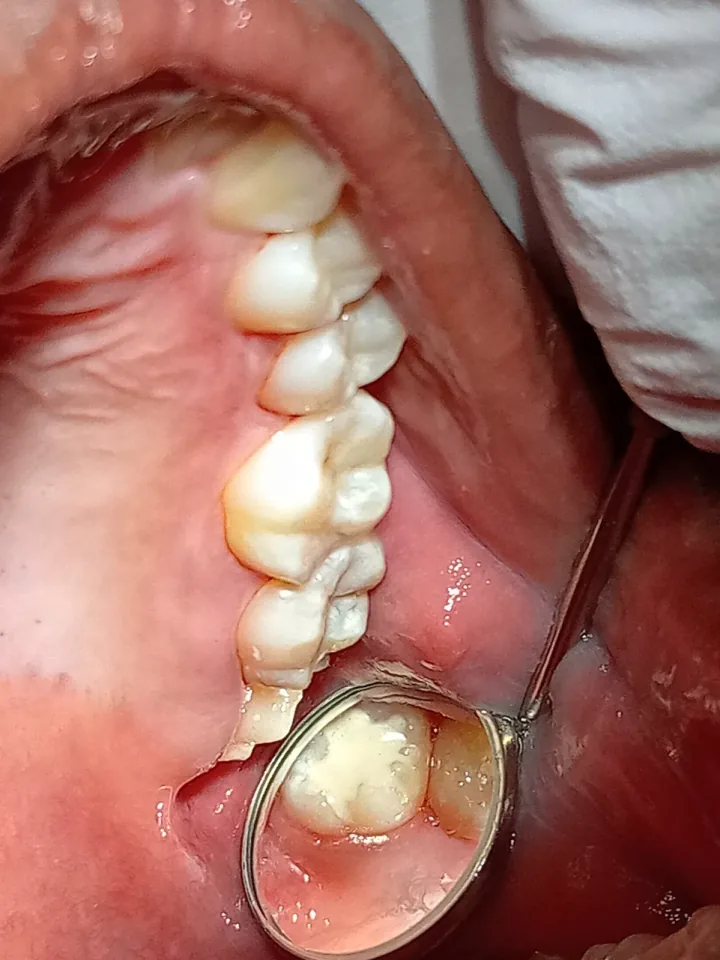
A teenaged patient asks what the pale material on the tooth in this photograph is. The assistant explains that it is:

Intraoral photograph of a lower back quadrant with the cheek held aside; a mouth mirror at the lower right reflects the chewing surface of a molar whose pits and fissures are filled with a pale opaque material, while the teeth seen directly look natural.
Image: Roquex · CC0 · source

Tap an answer

Answer: B. A sealant, a protective coating painted on as a barrier against decay

A sealant is a protective coating painted onto the chewing surface of a back tooth, where it acts as a barrier against the decay that starts in pits and fissures too narrow for a toothbrush bristle to clean. It goes onto sound enamel: nothing is drilled and no tooth structure is replaced, which is why a patient notices it as a pale layer that was not there before. A filling or a crown, by contrast, replaces tooth structure that has already been lost, and a whitening gel is applied for a session and then washed off rather than left in place.

Source: About Dental Sealants, Centers for Disease Control and Prevention; section “Overview”. U.S. government work, public domain.
Question 8

Chairside Dentistry

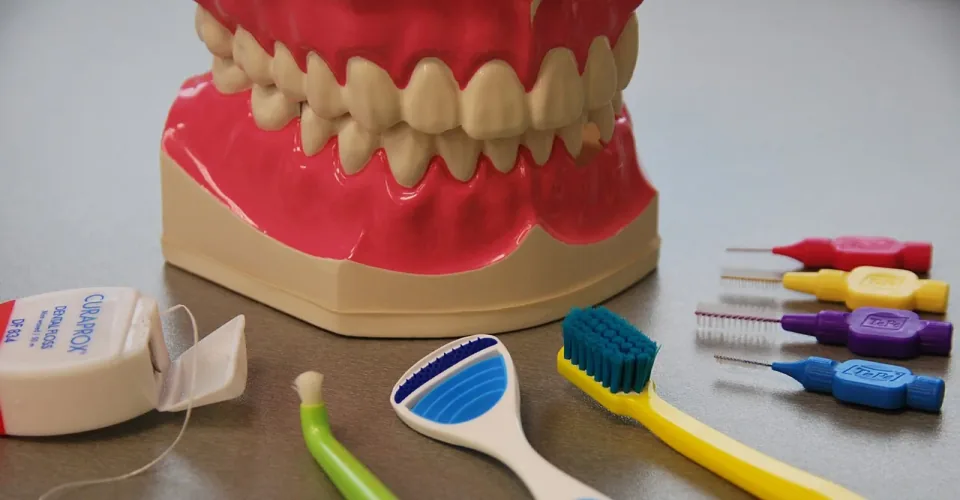
Home-care aids are shown beside a typodont. Which method removes plaque from the surfaces between the teeth, where toothbrush bristles cannot reach?

A typodont model of the upper and lower teeth on a bench, with home-care aids laid out in front of it: a boxed dispenser with a fine thread pulled out of it, a green rubber-tipped stick, a blue and white tongue cleaner, a yellow toothbrush with teal bristles, and four small color-coded brushes with fine tapered tips in graded sizes.
Image: Milenafoto · CC BY-SA 3.0 · source

Tap an answer

Answer: A. Dental floss, or an interdental brush if the gap is wider

NIDCR advises flossing regularly to remove plaque from between the teeth, and lists interdental brushes, picks and water flossers as alternatives for patients who cannot manage floss. A toothbrush cannot reach through a contact area no matter how firm the bristles, and harder bristles mainly abrade gingiva and exposed root surfaces. A rinse washes over the surfaces but does not mechanically disrupt the sticky plaque biofilm, which is why patients who 'brush well' but skip interdental cleaning still develop decay and gingivitis between the teeth.

Source: Periodontal (Gum) Disease, National Institute of Dental and Craniofacial Research; section “Helpful Tips”. U.S. government work, public domain.
Question 9

Chairside Dentistry

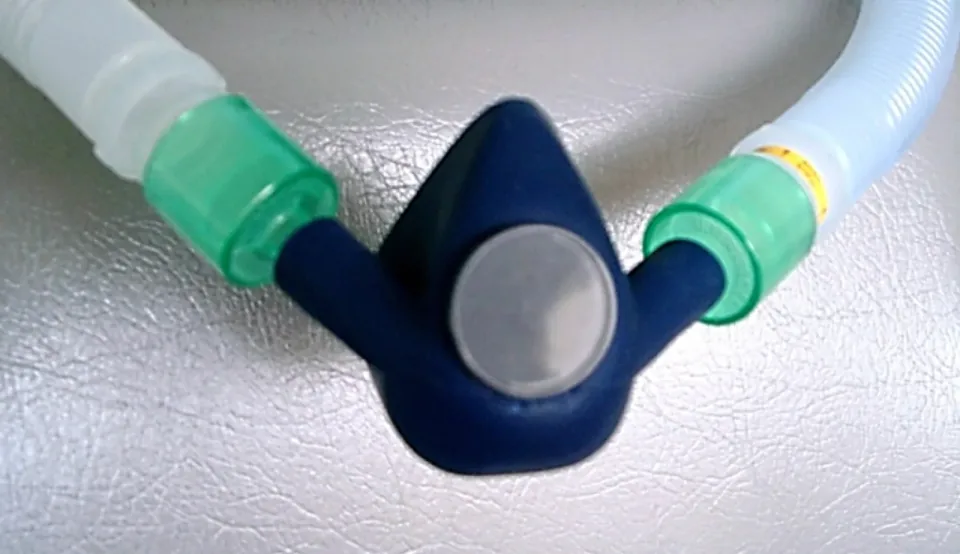
The nasal hood shown has a hose connected on each side. One brings the nitrous oxide/oxygen mixture to the patient. What is the other one for?

A dark blue triangular nasal hood lying on a white surface, a pale round disc set into its front and a green connector on each side joining a ribbed flexible hose.
Image: Sch1912 · CC BY-SA 4.0 · source

Tap an answer

Answer: B. Carrying the gas the patient breathes out away from the room

One hose feeds the fresh nitrous oxide/oxygen mixture into the hood; the other is joined to the vacuum, so the gas the patient breathes out - along with the excess the machine deliberately supplies - is drawn off and vented away instead of collecting in the air the team breathes all day. That second line is the scavenging line, and NIOSH treats scavenging as the control for nitrous oxide in dental operatories. The hood neither warms nor measures anything, and oxygen saturation, when it is watched at all, comes from a separate monitor.

Source: Dental Operatories: Control of Nitrous Oxide (Engineering Controls Database), National Institute for Occupational Safety and Health; section “Problem:”. U.S. government work, public domain.

Question 10

Dental Materials

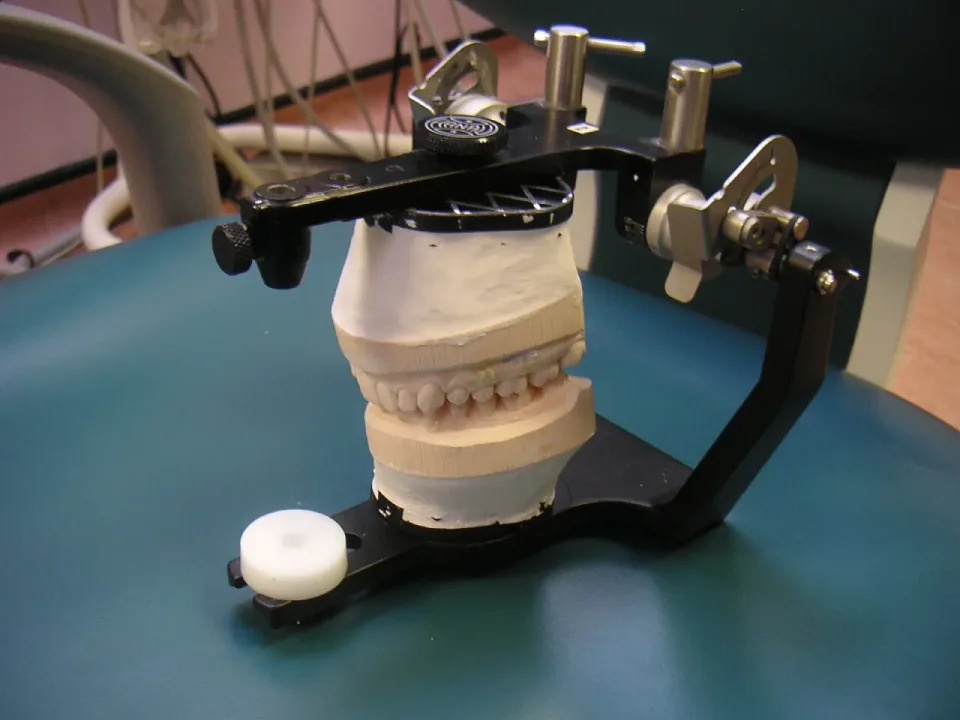
The upper and lower gypsum casts shown are mounted in occlusion on an articulator. Mounting casts on that instrument lets the dental team:

Upper and lower gypsum dental casts held with their teeth meeting, clamped between the two arms of a black bench-top articulator; a pale mounting band bonds the trimmed flat base of each cast to the arm beyond it, and adjusting screws stand at the rear.
Image: Lee Haywood · CC BY-SA 2.0 · source

Tap an answer

Answer: A. Reproduce the patient's jaw movements while the prosthesis is fabricated

An articulator is a bench instrument that reproduces the patient's jaw movements. Casts poured from the impressions are mounted on it in the relationship a bite registration recorded, so the dentist and the laboratory technician can recreate the way that jaw actually moves while a crown, bridge or denture is being fabricated, with the patient not in the chair. The other three cannot happen on a mounted cast: set gypsum cannot be softened and poured a second time, etchants condition enamel and dentin rather than stone, and autoclave heat and steam would wreck a gypsum cast outright.

Source: Dental Technician, Volume 2 (NAVEDTRA 14275), U.S. Navy, 1999; section “ARTICULATOR”. U.S. government work, public domain.

Answer every question to see your score and how it splits by domain.

330 questions in the app

Keep going in Dentalingo

The other 320 questions for the DANB® GC exam, with the same explanations, lessons across its four domains, and a mock exam of 95 questions in 75 minutes.

The first 7 questions are free. After that, full access is a Study Camp subscription; the App Store shows the price in your country. More about the app

Download on the App Store
  • Dentalingo's Practice screen: daily quests and the questions due for spaced-repetition review.Spaced review of what you missed
  • Dentalingo's question screen: a chairside question about a blood pressure reading, answered correctly, with the explanation below the options.Answers explained the moment you choose
  • Dentalingo's Stats screen: answers graded, XP per day and an accuracy trend.XP and accuracy over time

Think an answer is wrong? Write to us with the question number and the page; every question is checked against its source, and a confirmed error is corrected in the app as well.