Skip to content

Free practice test 2 · from 270 questions

Infection Control practice test 2, every answer explained

Another free sample from Dentalingo’s 270 questions for the DANB® ICE® exam, none of them from practice test 1. Tap an answer to see at once whether it’s right, why, and the source it was checked against. The other 260, a timed mock exam and spaced review are in the app.

The format and domains are in the Infection Control exam guide; how the questions are checked is on the sources page.

Question 1

Prevention of Cross-contamination

The heavy, long-cuffed gloves pictured are general-purpose utility gloves, kept for instrument cleaning and surface disinfection. How does their regulatory standing differ from that of the examination gloves worn at chairside?
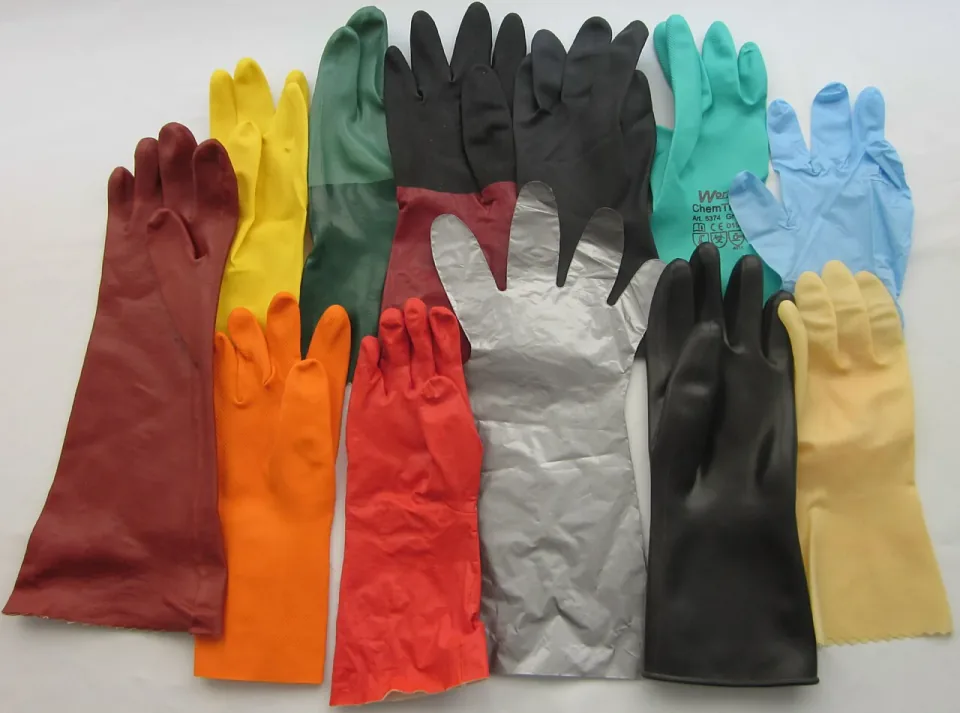
Assortment of heavy chemical-resistant utility gloves in latex, nitrile, neoprene and butyl, all with long cuffs that extend over the wrist
Image: Work-psa · CC BY-SA 3.0 · source

Tap an answer

Answer: D. Utility gloves are not promoted for medical use, so FDA does not regulate them

FDA regulates the medical glove industry, which takes in sterile surgeon's gloves and sterile or nonsterile patient examination gloves, and it sets acceptable quality levels for those manufacturers, with more rigorous standards applied to surgeon's gloves than to examination gloves. General-purpose utility gloves are used throughout dental offices but sit outside that system, because they are not promoted for medical use. They are therefore never a substitute for examination gloves at chairside, and it falls to the practice to judge when a pair has deteriorated.

Source: Guidelines for Infection Control in Dental Health-Care Settings, 2003, Centers for Disease Control and Prevention (MMWR 52, RR-17); section “Gloves and Gloving”. U.S. government work, public domain.
Question 2

Prevention of Cross-contamination

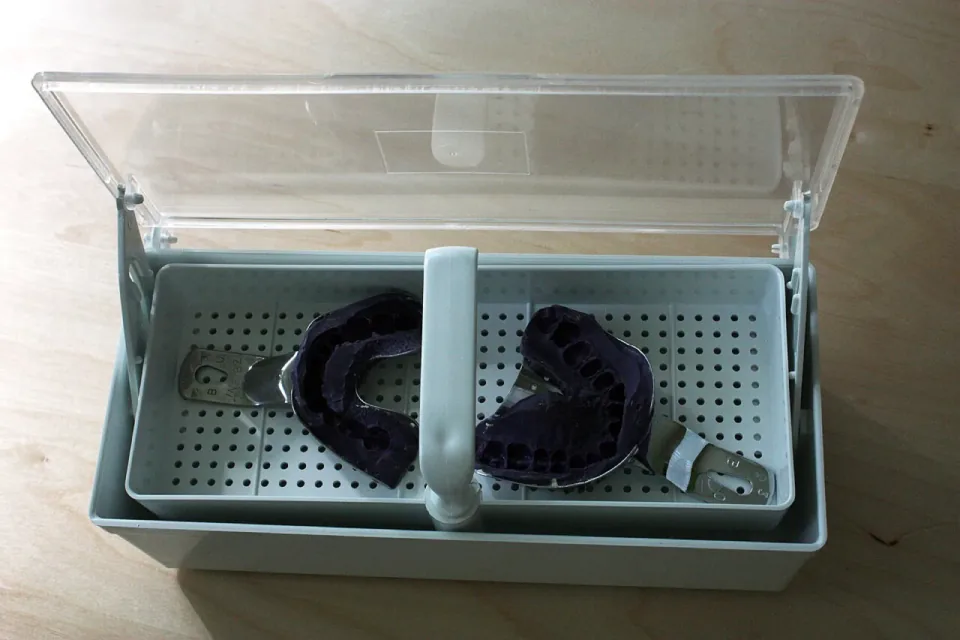
Two set impressions sit in the perforated basket of an immersion container, as shown, cleaned and ready to be disinfected. Before an office adopts immersion for a particular impression material, CDC directs the team to:

Two set dark-purple dental impressions in metal perforated stock trays lying in a perforated plastic strainer basket inside a clear-lidded plastic immersion container on a bench
Image: Politikaner · CC BY-SA 3.0 · source

Tap an answer

Answer: B. Ask the material's manufacturer whether it stays stable through disinfection

Immersion exposes an impression to a germicide for the whole labeled contact time, and materials differ in how well they survive that. CDC advises personnel to consult manufacturers regarding the stability of specific materials during disinfection, and names damage or distortion from disinfectant overexposure as one of the failures that coordination between office and laboratory is meant to prevent. Cutting the exposure short leaves the impression undisinfected, elastomers are not the only materials that may be immersed, and pouring first carries contamination onto the model and the bench.

Source: Guidelines for Infection Control in Dental Health-Care Settings, 2003, Centers for Disease Control and Prevention (MMWR 52, RR-17); section “Dental Laboratory”. U.S. government work, public domain.
Question 3

Prevention of Cross-contamination

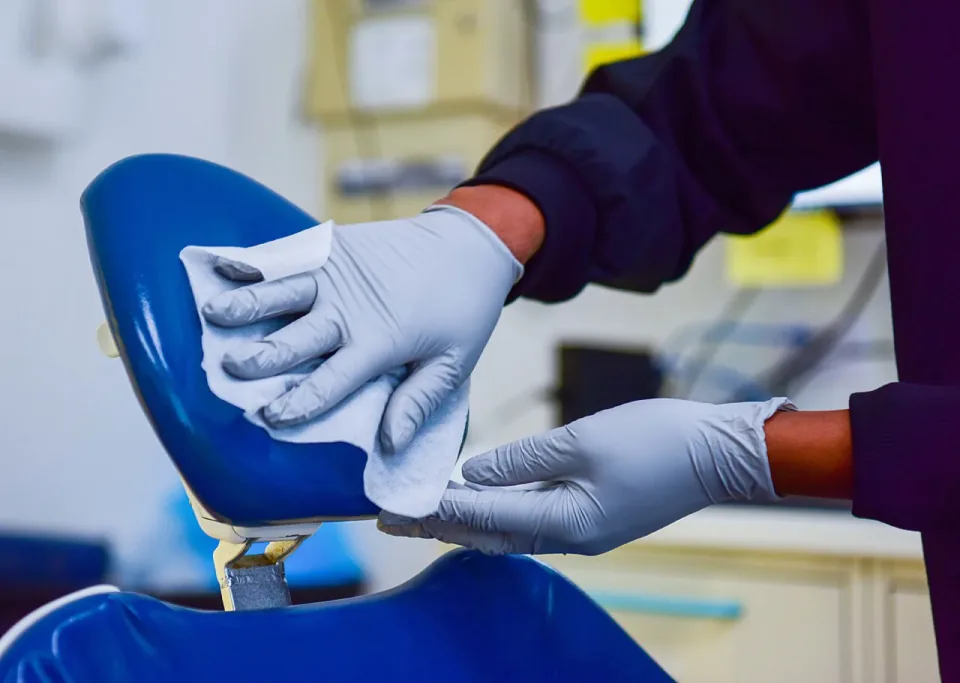
Between patients an assistant cleans and disinfects the dental chair with the disposable wipe shown. CDC states that the cleaning methods preferred in patient-care areas are the ones that:

Two gloved hands wiping the blue upholstered headrest of a dental chair with a white disposable wipe, an operatory counter blurred behind
Image: U.S. Air Force photo by Senior Airman Jessica Blair · Public domain · source

Tap an answer

Answer: B. Produce minimal mists, aerosols and dispersion of dust in the patient-care area

CDC's environmental cleaning guidance covers how a surface is cleaned, not only what is applied to it: preferred cleaning methods produce minimal mists and aerosols or dispersion of dust in patient-care areas, because whatever is lifted off one surface settles onto another. Wiping keeps that dispersal low. Cost, safety and product-surface compatibility are real criteria, but they guide the choice of a cleaning agent rather than the method. Concentration and contact time are set by the product label, not by the operator, and speed is never the yardstick, since the surface must stay wet for the labeled time.

Source: Guidelines for Infection Control in Dental Health-Care Settings, 2003, Centers for Disease Control and Prevention (MMWR 52, RR-17); section “Housekeeping Surfaces”. U.S. government work, public domain.
Question 4

Prevention of Cross-contamination

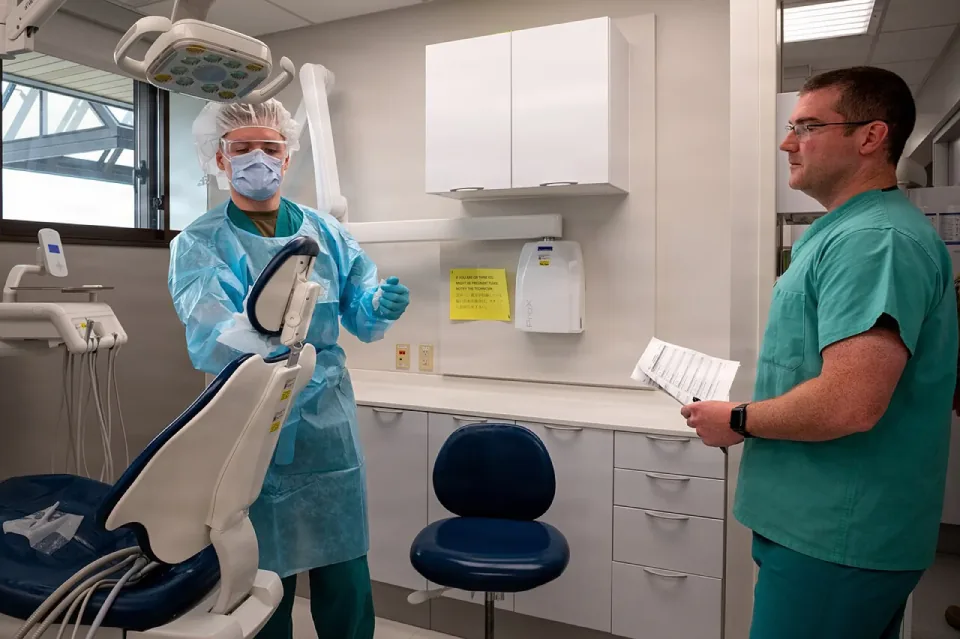
The assistant shown — gowned, masked, eye-protected and gloved — is turning over the operatory after a patient has been dismissed. Besides the handling they get between patients, what does CDC recommend for clinical contact surfaces, dental unit surfaces and countertops?

A dental assistant in a disposable gown, surgical mask, wraparound safety glasses, bouffant cap and gloves stands at the raised back of an empty dental chair in an operatory while a second person in scrubs watches holding a checklist; unsheathed handpiece tubing hangs from the delivery arm
Image: U.S. Air Force photo by Airman 1st Class Jessel Fabara · Public domain · source

Tap an answer

Answer: A. General cleaning and disinfection at the end of daily work activities

Between-patient handling is only part of the schedule. CDC recommends general cleaning and disinfection of clinical contact surfaces, dental unit surfaces and countertops at the end of daily work activities, and requires it if those surfaces have become contaminated since their last cleaning. That daily pass picks up what a barrier covered all day and what spatter reached unnoticed. Keeping treatment areas free of unnecessary equipment and supplies is what makes it practical. A liquid chemical sterilant is never applied to an environmental surface, and no interval longer than a day is offered.

Source: Guidelines for Infection Control in Dental Health-Care Settings, 2003, Centers for Disease Control and Prevention (MMWR 52, RR-17); section “Clinical Contact Surfaces”. U.S. government work, public domain.
Question 5

Process Instruments and Devices

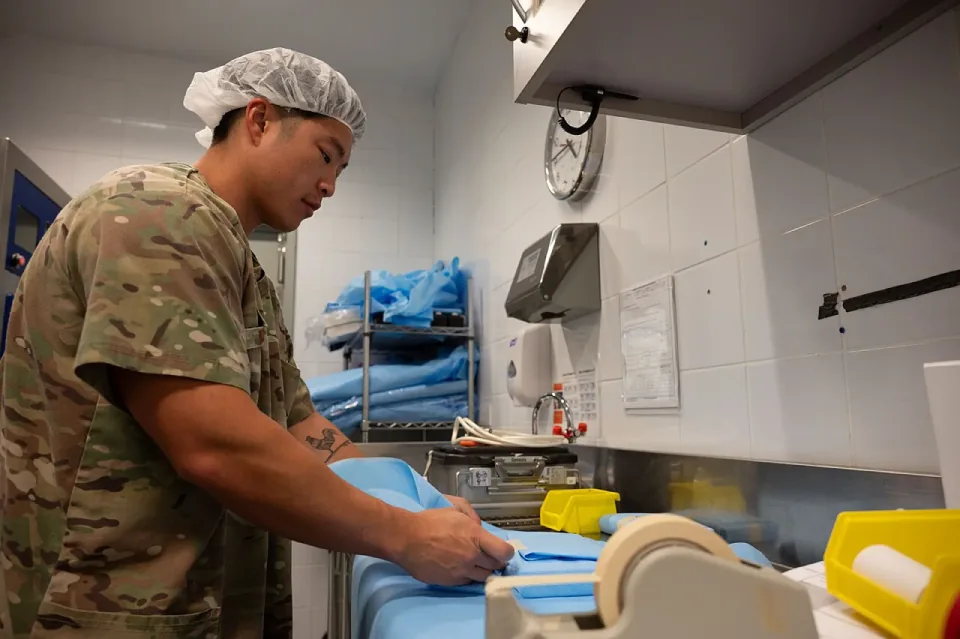
The technician shown is wrapping a cleaned instrument set at the preparation and packaging bench. Before instruments are assembled into a set and wrapped, CDC directs that they be:

Dental technician wearing a hair cover wrapping an instrument set in blue sterilization wrap at a sterile processing bench, with a roll of indicator tape at hand
Image: U.S. Air Force photo by Senior Airman Dieondiere Jefferies · Public domain (US Air Force) · source

Tap an answer

Answer: A. Inspected to confirm the cleaning step removed the debris, then assembled into sets

CDC divides instrument processing into four sections, and this bench is the preparation and packaging one: cleaned instruments and supplies are inspected, assembled into sets or trays, and wrapped or placed into container systems for sterilization. Inspection matters because any debris cleaning missed will shield microorganisms from the sterilant. Nothing here is sterile yet, so instruments are still handled as though contaminated, and no chemical dip belongs in the sequence. The label a package needs is the sterilization date and, in a multi-sterilizer office, which unit ran the load.

Source: Guidelines for Infection Control in Dental Health-Care Settings, 2003, Centers for Disease Control and Prevention (MMWR 52, RR-17); section “Preparation and Packaging”. U.S. government work, public domain.
Question 6

Process Instruments and Devices

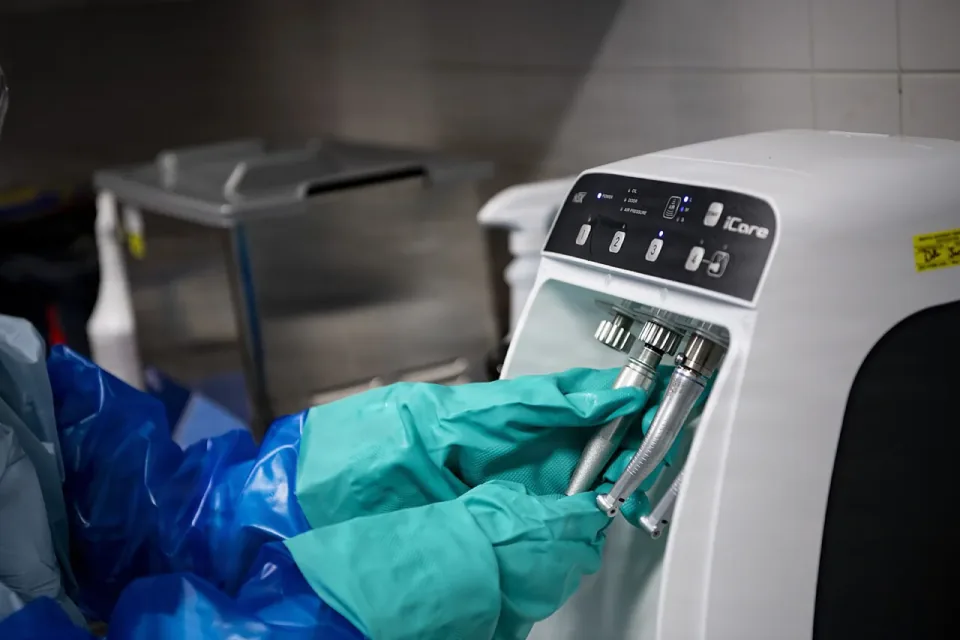
The assistant shown is seating used handpieces in an automated cleaning and lubrication unit. When that unit's cycle finishes, the handpieces:

Hands in heavy green utility gloves and a blue gown seating two metal dental handpieces onto the coupling spigots of a benchtop automated handpiece cleaning and lubrication unit with a numbered control panel
Image: U.S. Air Force photo by Senior Airman Tallon Bratton · Public domain · source

Tap an answer

Answer: C. Still have to be heat sterilized before they go back on the dental unit for a patient

Cleaning and lubrication were the most critical factors for handpiece performance and durability in clinical evaluations, which is why offices buy units like this one, but the unit is not a sterilizer. CDC directs that handpieces and other intraoral instruments removable from the air and waterlines of dental units be cleaned and heat sterilized between patients, following the validated manufacturer instructions for cleaning, lubrication and sterilization. An automated maintenance cycle is a preparation step in that sequence, never the final one.

Source: Best Practices for Dental Handpieces, Centers for Disease Control and Prevention; section “Key points”. U.S. government work, public domain.
Question 7

Occupational Safety and Administration Protocols

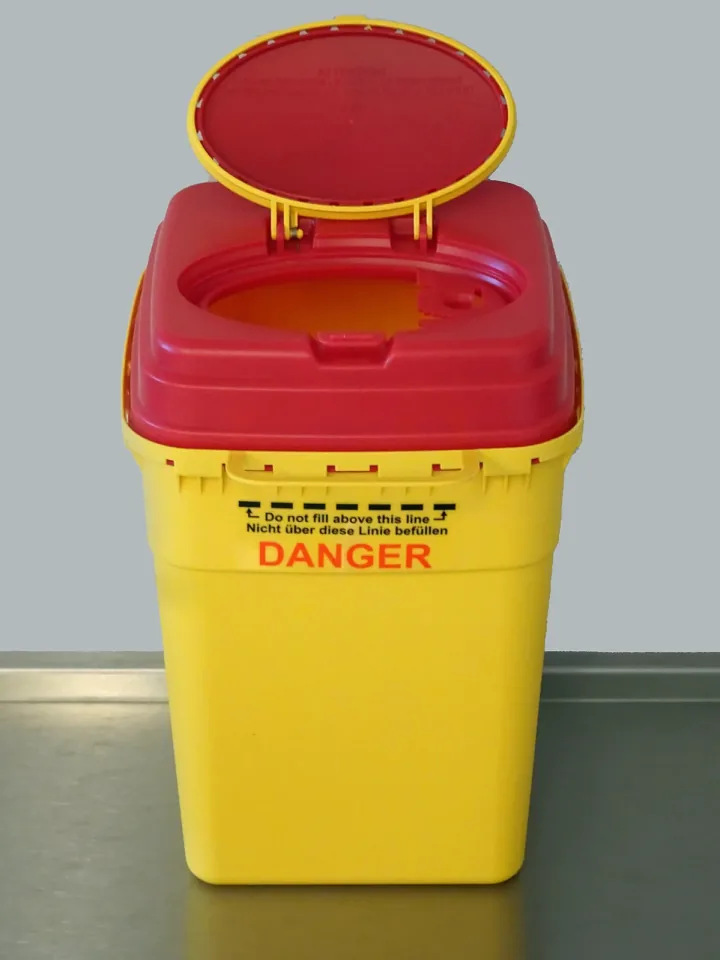
A sharps container like the one pictured is kept chairside. When the contents reach the marked fill line, the assistant should:

Yellow puncture-resistant sharps container with red lid open and a marked fill line labeled DANGER
Image: Stefan Bellini · CC0 · source

Tap an answer

Answer: B. Close the container and replace it with a new one

OSHA requires sharps containers during use to be replaced routinely and never allowed to overfill — the fill line signals when to close the lid and swap in a new container. Containers must also be closable, puncture resistant, leakproof on sides and bottom, labeled or color-coded, kept upright, and located close to where sharps are used. Never press contents down or reach inside.

Source: 29 CFR 1910.1030, Bloodborne Pathogens, Occupational Safety and Health Administration; section “During use, containers for contaminated sharps shall be”. U.S. government work, public domain.
Question 8

Occupational Safety and Administration Protocols

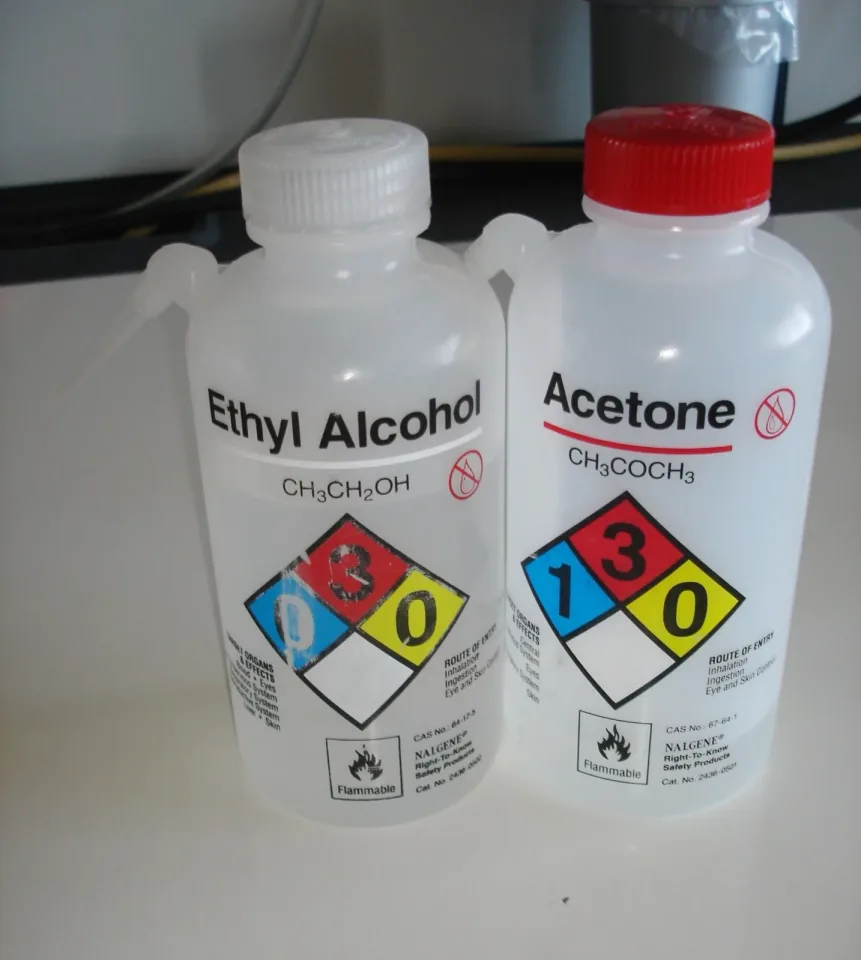
The practice buys bulk solvent and keeps it in the workplace dispensing bottles pictured. Each label gives the product name, a four-colour hazard rating diamond, a flammable symbol, target organs, route of entry and a CAS number, but it carries no GHS signal word and no red-bordered pictogram. Under the Hazard Communication Standard this labelling is:

Two translucent plastic dispensing bottles on a bench, one labelled Ethyl Alcohol CH3CH2OH with a white cap and side spout and one labelled Acetone CH3COCH3 with a red cap, each label carrying a four-colour NFPA 704 hazard diamond, a Flammable flame symbol, target organs and effects, route of entry and a CAS number
Image: Nuno Nogueira (Nmnogueira) · CC BY-SA 2.5 · source

Tap an answer

Answer: C. Acceptable, because a workplace container may use another system that conveys the hazards

The standard offers two routes for a container already in the workplace. One repeats the shipped-label information. The other is a product identifier plus words, pictures or symbols giving at least general information about the hazards, which together with what the hazard communication program makes available conveys the specific physical and health hazards. A rating diamond with target organs, route of entry and a flammable symbol takes that second route. The signal-word format binds whoever ships the container, not the office refilling one.

Source: 29 CFR 1910.1200, Hazard Communication, Occupational Safety and Health Administration; section “1910.1200(f)(6)(ii)”. U.S. government work, public domain.
Question 9

Occupational Safety and Administration Protocols

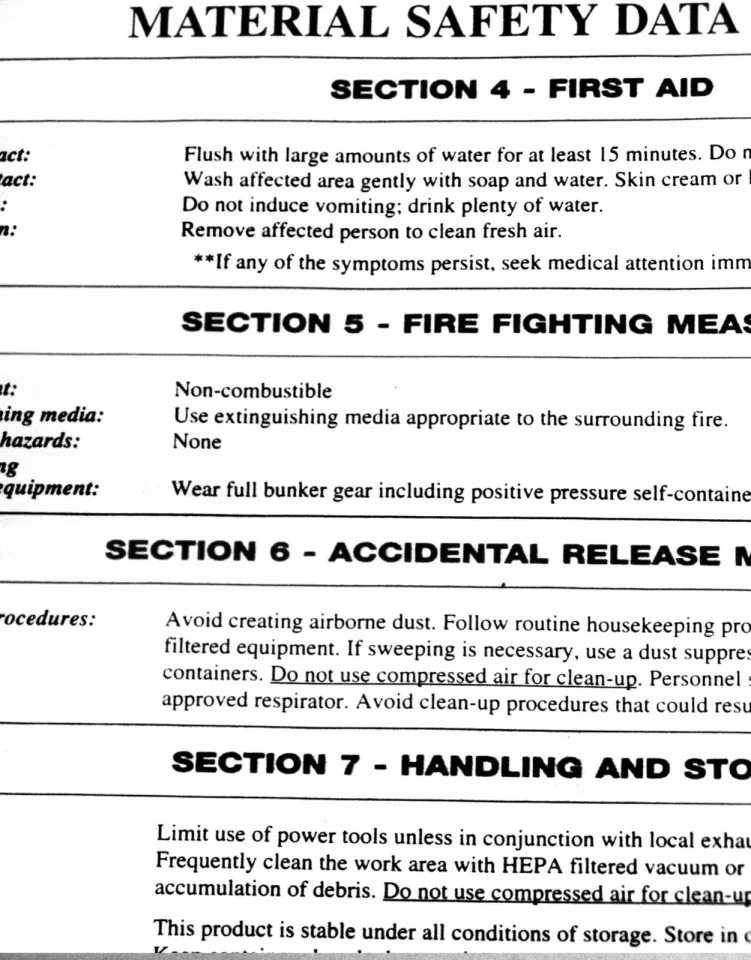
The sheet pictured is open at Sections 4 through 7. Before handling the product, an assistant wants to know which gloves and eye protection its maker specifies. Because every sheet numbers its sections the same way and presents them in the same order, that information is in:

Printed safety data sheet showing numbered sections including Section 4 First Aid, Section 5 Fire Fighting Measures, Section 6 Accidental Release and Section 7 Handling and Storage
Image: Jeffrey M. Vinocur · CC BY 2.5 · source

Tap an answer

Answer: A. Section 8, Exposure controls and personal protection

A safety data sheet is standardized: sixteen numbered sections, the same headings in the same order, which is what lets someone find one kind of information without reading the whole document. Exposure controls and personal protection is Section 8, listing any exposure limits and the gloves, eye protection and respiratory protection the manufacturer specifies. Hazard identification gives the signal word and pictograms, physical and chemical properties describes the substance, and toxicological information covers health effects.

Source: 29 CFR 1910.1200, Hazard Communication, Occupational Safety and Health Administration; section “1910.1200(g)(2)(viii)”. U.S. government work, public domain.

Question 10

Occupational Safety and Administration Protocols

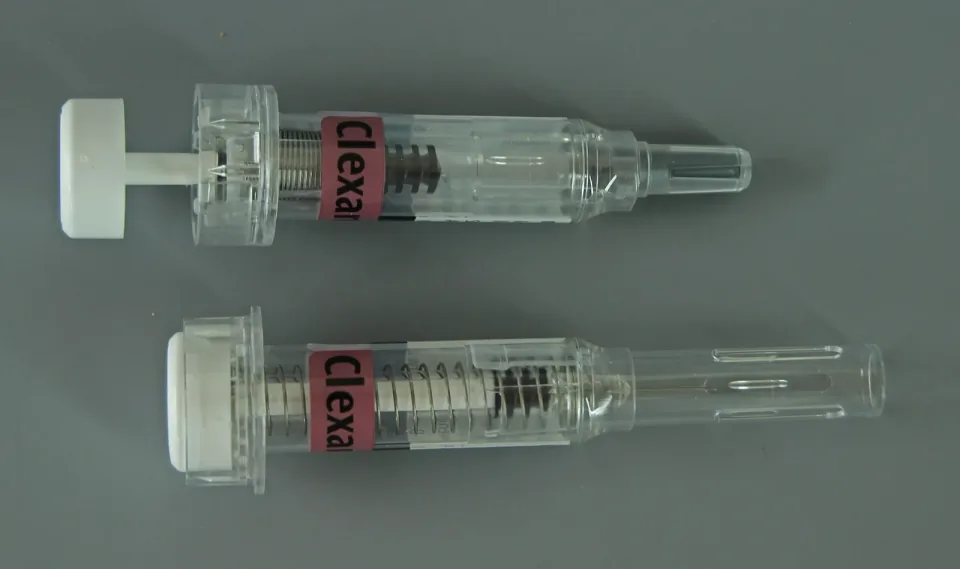
The pictured device is a safety-engineered sharp: the same syringe before use and after use, with a sleeve slid forward and locked over the needle. A practice is deciding whether to change over to devices of this kind. Besides documenting the annual review, the Bloodborne Pathogens Standard requires the employer to:

Two prefilled syringes side by side on a grey background: the upper one before use with its needle hidden under a rigid tip cap, the lower one after use with the plunger fully depressed and a transparent slotted safety sleeve slid forward so the needle is enclosed inside it
Image: Frank C. Müller · CC BY-SA 4.0 · source

Tap an answer

Answer: D. Solicit input from the non-managerial staff who use sharps and record it in the plan

The employer must solicit input from non-managerial employees giving direct patient care who are exposed to sharps injuries, when identifying, evaluating and selecting engineering and work practice controls, and must document it in the exposure control plan. The people holding the device find out whether the safety feature really works one-handed at chairside. Nothing requires telling OSHA about a purchase, the vaccination offer follows assignment to exposed work rather than a product, and the sharps injury log records injuries, not equipment.

Source: 29 CFR 1910.1030, Bloodborne Pathogens, Occupational Safety and Health Administration; section “1910.1030(c)(1)(v)”. U.S. government work, public domain.
Answer every question to see your score and how it splits by domain.

270 questions in the app

Keep going in Dentalingo

The other 260 questions for the DANB® ICE® exam, with the same explanations, lessons across its four domains, and a mock exam of 75 questions in 60 minutes.

The first 7 questions are free. After that, full access is a Study Camp subscription; the App Store shows the price in your country. More about the app

Download on the App Store
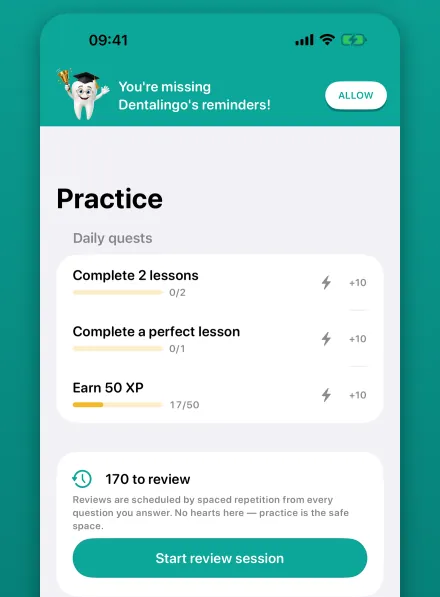
  • Dentalingo's Practice screen: daily quests and the questions due for spaced-repetition review.Spaced review of what you missed
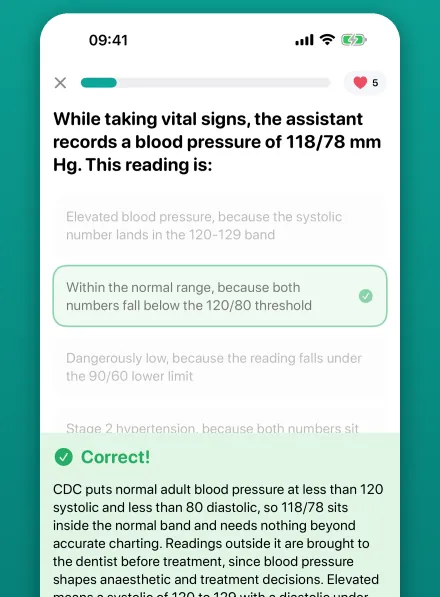
  • Dentalingo's question screen: a chairside question about a blood pressure reading, answered correctly, with the explanation below the options.Answers explained the moment you choose
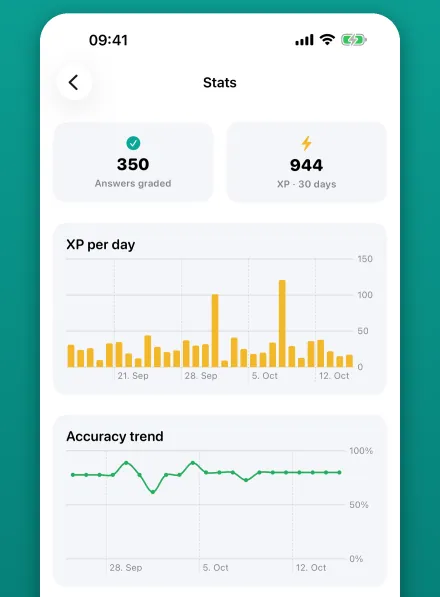
  • Dentalingo's Stats screen: answers graded, XP per day and an accuracy trend.XP and accuracy over time

Think an answer is wrong? Write to us with the question number and the page; every question is checked against its source, and a confirmed error is corrected in the app as well.