
Skip to content

Free practice test · from 200 questions

Coronal Polishing practice test, every answer explained

A free sample from Dentalingo’s 200 questions for the DANB® CP exam. Tap an answer to see at once whether it’s right, why, and the source it was checked against. The other 190, a timed mock exam and spaced review are in the app.

The format and domains are in the Coronal Polishing exam guide; how the questions are checked is on the sources page.

Question 1

Evaluation

Refined sugar dissolves in the mouth and penetrates the soft deposit on a patient's molars. What do the micro-organisms inside it then do that starts decay?

Tap an answer

Answer: A. They metabolise it into an acid that is held against the enamel

The subcourse describes carbohydrate going into solution, penetrating the deposit, and being metabolised there into acid. Because that acid is held in place and sits directly against the tooth, it demineralises enamel and begins caries. The pigment answer describes stain, the calcium answer describes the mineralisation that turns the deposit hard, and the toxin answer describes the separate route by which deposit near the gum margin harms periodontal tissue.

Source: Preventive Dentistry (subcourse MD0513), U.S. Army Medical Department Center and School; section “2-10. DENTAL PLAQUES”. U.S. government work, public domain.

Question 2

Equipment and Supplies

Federal regulation defines the abrasive that is added to a dentifrice by the job it is there to do. What job is that?

Tap an answer

Answer: B. Taking plaque, debris and stain off the surfaces of the tooth

The regulation's definition is functional and names three things to be removed: plaque, debris and stain, taken off the tooth mechanically. Putting a shine on enamel that is already clean is not the job it names, and holding the formulation together or delivering the active ingredient are the work of other components of the product.

Source: 21 CFR Part 355, Anticaries Drug Products for Over-the-Counter Human Use, U.S. Food and Drug Administration (CFR 2024, govinfo); section “355.3 Definitions”. U.S. government work, public domain.
Question 3

Equipment and Supplies

A dental assistant turns out to be allergic to the gloves the practice normally stocks. What does the bloodborne pathogens standard require the employer to do?

Tap an answer

Answer: B. Keep suitable alternatives, such as glove liners, readily to hand

The standard answers an allergy by changing the glove rather than the person's duties or their paperwork: substitutes that avoid the offending material, among them liners and powder-free stock, must be within reach of a worker who reacts to what is normally issued. Reassignment, self-supply and medical clearance are not what the rule asks for.

Source: 29 CFR 1910.1030, Bloodborne Pathogens, Occupational Safety and Health Administration; section “1910.1030(d)(3)(iii)”. U.S. government work, public domain.
Question 4

Procedures

As the paste builds up during the run, how is the working area kept clear?

Tap an answer

Answer: D. Water is flushed in and the patient holds the saliva ejector

Clearing as you go keeps the surface visible and stops slurry pooling in the floor of the mouth. Water comes from the three-way syringe, and the patient is handed the low-volume tip so debris is drawn off continuously. Leaving everything until the end makes the surfaces still to come much harder to judge.

Source: Dental Technician, Volume 2 (NAVEDTRA 14275), U.S. Navy, 1999; section “Polishing Routine”. U.S. government work, public domain.

Question 5

Procedures

A bristle brush is chosen over the cup when the operator reaches:

Tap an answer

Answer: A. the chewing surfaces, with their pits and grooves

Stiff bristles reach down into a groove that a smooth rubber rim simply rides over, so the brush is kept for the occlusal table and the fissure pattern within it. Wherever the surface is broad and smooth, or close to soft tissue, the cup is the safer carrier. Closed contacts remain the job of floss or tape.

Source: Preventive Dentistry (subcourse MD0513), U.S. Army Medical Department Center and School; section “3-21. POLISHING WITH PROPHYLAXIS PASTE”. U.S. government work, public domain.

Question 6

Procedures

The bristle brush is being run over the biting surfaces. How close to the gum may it be taken?

Tap an answer

Answer: A. Well clear of the gum, with the bristles kept off the soft tissues

The brush is the stiffest of the three carriers, so its permitted ground is the occlusal table and a margin of clear space is asked for between the bristles and the tissue. Bringing it down to the neck of a tooth, or letting it graze a margin that merely looks healthy, throws that margin of safety away. Running the handpiece slowly does not buy back the clearance.

Source: Dental Technician, Volume 2 (NAVEDTRA 14275), U.S. Navy, 1999; section “Precautions”. U.S. government work, public domain.

Question 7

Procedures

Why is the operator warned against letting the cup drag against one spot on a tooth?

Tap an answer

Answer: B. The heat that builds up can reach the pulp and cause pain

Rubber turning against enamel makes heat, and a cup that lingers over one point raises the temperature there faster than the tooth can carry it away. The same paragraph deals with that by holding the handpiece to its lowest speed and never letting the cup rest, so no one spot is loaded for long. The patient feels it as pain, and it is the pulp the warning is protecting.

Source: Dental Technician, Volume 2 (NAVEDTRA 14275), U.S. Navy, 1999; section “Precautions”. U.S. government work, public domain.

Question 8

Procedures

How is paste kept from flying about as each new surface is started?

Tap an answer

Answer: C. The cup is brought up to the tooth first, then set turning

A loaded cup that is already turning throws its contents outward before it ever meets a tooth. Closing the gap first and starting the rotation almost against the surface keeps the abrasive where it was put. This is a matter of the order of two actions, not of how much paste was loaded.

Source: Dental Technician, Volume 2 (NAVEDTRA 14275), U.S. Navy, 1999; section “Precautions”. U.S. government work, public domain.

Question 9

Procedures

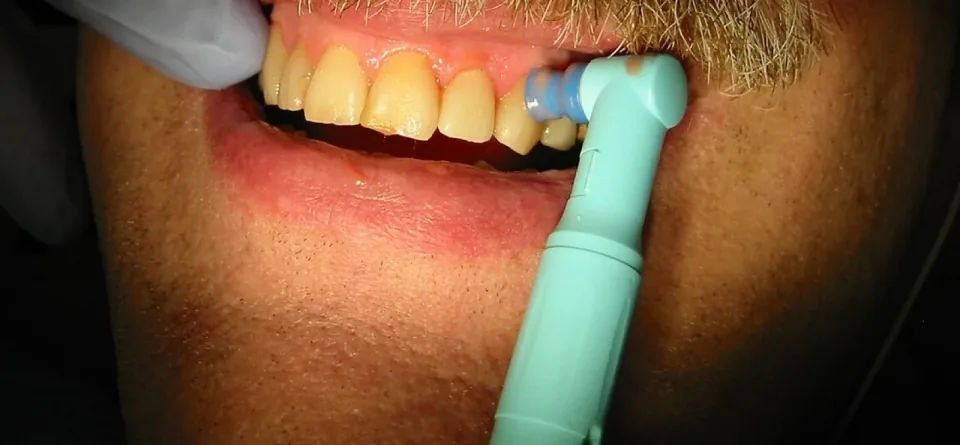
The cup shown has finished the open surfaces of the arch. Besides carrying paste into the spaces between the teeth, what does the floss pass do?

A gloved finger holds back the upper lip. A mint-green prophy angle enters from the right and its small blue rubber cup is pressed against the outer surface of an upper back tooth; the neighbouring upper teeth meet one another at closed contacts alongside the cup.
Image: Walter Siegmund (image cropped) · CC BY 2.5 · source

Tap an answer

Answer: C. It lifts that same material out again as it is drawn through

The floss does two jobs in one pass. It is the only carrier that will enter a closed contact, so the polishing agent goes in on it; and drawing it through lifts that agent out again, which is the purpose the manual states for the step. Burnishing a contact against future stain is not a claim the manual makes, the pass does not stand in for the rinse that ends the appointment, and nothing is meant to be left behind between the teeth.

Source: Preventive Dentistry (subcourse MD0513), U.S. Army Medical Department Center and School; section “3-14. POLISHING”. U.S. government work, public domain.

Question 10

Administration

A patient points to the yellow-brown banding across her front teeth, which dates from an antibiotic she was given as a small child, and asks whether a polish can take it off. Which reply should the dental assistant give her?

Tap an answer

Answer: D. No paste can reach it, because the colour lies within the enamel and the dentin.

A discolouration laid down while the teeth were forming is carried inside the tooth. The pigment is taken up into the crystal structure of enamel and dentin, so there is nothing on the surface for a cup, a brush or a paste to lift off. More minutes on the tooth, a coarser grit or a change of attachment all work on the outside, which is not where this colour sits, and it is not a deposit that re-forms after a polish either. Changing how the banding looks is a treatment-planning discussion, not something a polish can deliver.

Source: Preventive Dentistry (subcourse MD0513), U.S. Army Medical Department Center and School; section “2-12. STAINS”. U.S. government work, public domain.

Answer every question to see your score and how it splits by domain.

200 questions in the app

Keep going in Dentalingo

The other 190 questions for the DANB® CP exam, with the same explanations, lessons across its four domains, and a mock exam of 80 questions in 60 minutes.

The first 7 questions are free. After that, full access is a Study Camp subscription; the App Store shows the price in your country. More about the app

Download on the App Store
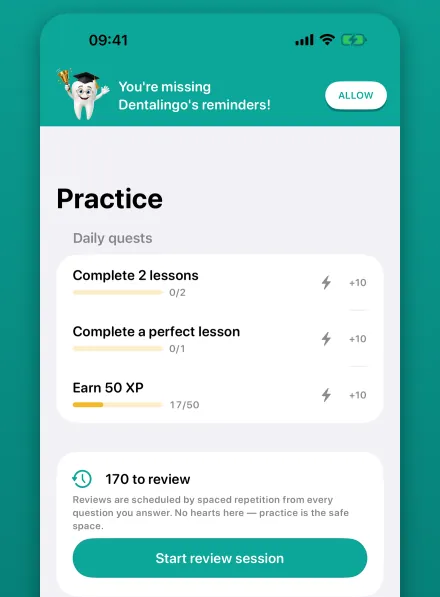
  • Dentalingo's Practice screen: daily quests and the questions due for spaced-repetition review.Spaced review of what you missed
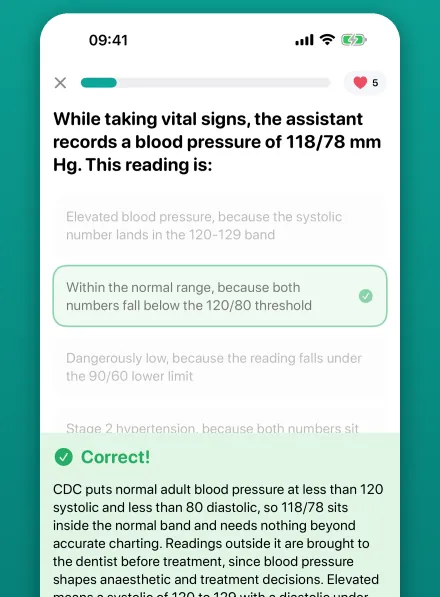
  • Dentalingo's question screen: a chairside question about a blood pressure reading, answered correctly, with the explanation below the options.Answers explained the moment you choose
  • Dentalingo's Stats screen: answers graded, XP per day and an accuracy trend.XP and accuracy over time

Think an answer is wrong? Write to us with the question number and the page; every question is checked against its source, and a confirmed error is corrected in the app as well.